Internet trends: marketing research & predictions

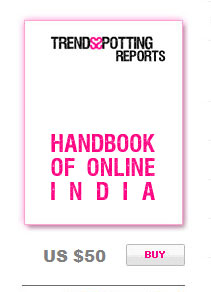
Handbook of Online India: New TrendsSpotting Report

August 17th, 2009 by

Buy now!
TrendsSpotting has released its new research cover: Handbook of Online India.

Globally India is the seventh largest internet market. However, its internet penetration of slightly less than 3% points to tremendous growth potential.

TrendsSpotting’s Handbook of Online India captures the most updated statistics covering modern India markets.

Tap into a wealth of internet and mobile users’ indications to better understand how India is vastly developing as one of the most interesting countries to follow.

This handbook includes 65 Power Point slides with statistical charts based on market research analyses.

The Handbook of Online India by chapters:
1. India Insider: Internet users demographics and habits.

2. Top Players in Online India: most popular websites, share of search, IM market shares.

3. India Online 2.0: global players, web 2.0 adoption (blogs, social networks, online videos).

4. India’s Digital Divide: Language adoption stats.

5. Indian Mobile Market: Penetration, growth, GSM versus CDMA subscribers, price per services, SMS growth, consumer satisfaction and loyalty,mobile music.

6. Business Perceptive – Online India: Advertising market, Online advertising, Online business, mobile ad market.

The Online India research report is second in Trendsspotting’s Online Handbook series.
Read our previous popular cover: TrendsSpotting Handbook of Online China.

Post to Twitter Tweet This Post Post to Plurk Plurk This Post Post to Yahoo Buzz Buzz This Post Post to Delicious Delicious Post to Digg Digg This Post Post to Ping.fm Ping This Post Post to Reddit Reddit Post to StumbleUpon Stumble This Post

Twitter’s shopping list: most common “must buy” tweets

August 15th, 2009 by

Many of us perceive Twitter as a tool to monitor consumer behavior. As Twitter reflects the live streaming thoughts and needs of consumers – what can be more insightful for marketers than following the “must buy” products Twitter users tweet about.
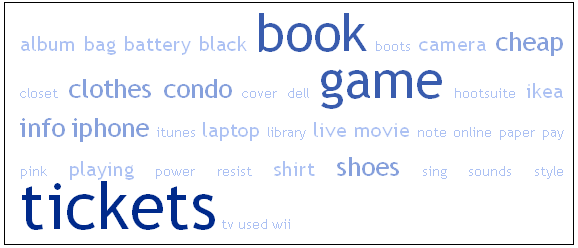
We have generated a tag cloud for 24 hours cycle of tweets containing the actionable words “must have”. We have worked hard to clean irrelevant words and came up with the following shopping list:

must_buy_twitter_shopping_list

You can see Twitter users tweet about their urge to buy tickets, books and games.  On the brands list we see:  iPhone, Ikea, Dell, Wii and iTunes. Most common products discussed are black and pink color.

Post to Twitter Tweet This Post Post to Plurk Plurk This Post Post to Yahoo Buzz Buzz This Post Post to Delicious Delicious Post to Digg Digg This Post Post to Ping.fm Ping This Post Post to Reddit Reddit Post to StumbleUpon Stumble This Post

New York In Fashion Crisis: 2009 Fashion Capital Media Research (#NY #fashion)

August 6th, 2009 by

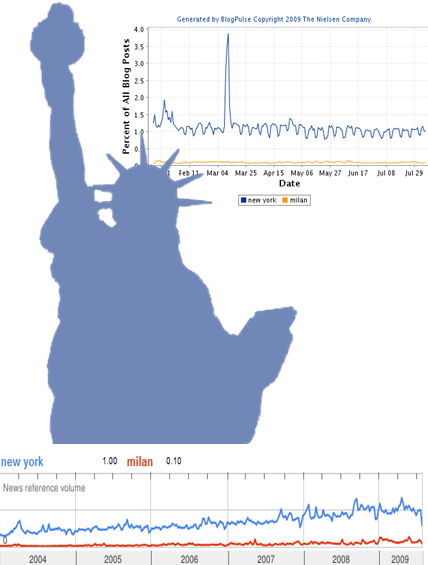
newyork The Big Apple may be beating Milan in search & blog discussions. However when it comes to fashion, recession forced a shift towards east. Milan, the home of Gucci, Prada, Armani and Versace, has ended New York’s five-year reign as the world’s top fashion city as per the Global Language Monitor’s annual fashion capital research. Other top runner includes Paris, Rome, London, Los Angeles and Hong Kong.

“The parties were not as big, that was enough to knock New York off just a bit. And Milan seems to have had a very strong fashion season, very well praised and a lot of noise about it.” – says Global Language Monitor president Paul JJ Payak.

The GLM list ranks the cities based on the frequency of fashion words and phrases like “haute couture” and “mode” in the media, on the Internet and throughout the blogosphere.

Racked contributor Cynthia Drescher comments

If that’s the case, then how come Paris didn’t win out considering that those are both French words? And obviously they haven’t been tuning in to blogs such as The Sartorialist, who claims New York as his base, or Susie Bubble, whose London frolicks should have swung more favor away from a Milan, generally known as the old guard of fashion.

Interestingly New York is the most populated Twitter city. So will Twitter pave it’s recovery to the top? Here is our initial attempt – a slide deck on 2009 fashion capital survey – brought to you exclusively by Trendsspotting. If you are as hurt as Gawker, tweet on this crisis #NY fashion. Hopefully this would help the Big Apple regaining the crown next year.

2009 Fashion Capital Media Research #NYFashion by TrendsSpotting

Post to Twitter Tweet This Post Post to Plurk Plurk This Post Post to Yahoo Buzz Buzz This Post Post to Delicious Delicious Post to Digg Digg This Post Post to Ping.fm Ping This Post Post to Reddit Reddit Post to StumbleUpon Stumble This Post

Apple is Risking its Brand Image

July 29th, 2009 by

apple_google_voice

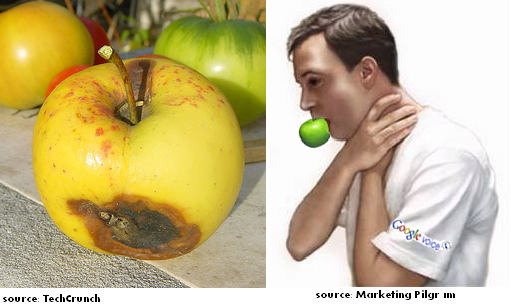
Just as Apple succeeded to light consumers’ enthusiasm once again with Apple’s tablet (Twitter tweets:  trend volume, mostly positive sentiments), Apple seems to be risking its well known reputation.

Since the launch of the iPhone, the Apple brand was influenced by negative attitudes towards AT&T, mostly for issues of connectivity and costs. Only thanks to its brands strength (high involvement among Apple’s fans, high emotional engagement, design and innovation credits) Apple’s brand image was protected.

It seems today this status quo might change as Google Voice service is getting pulled from Apple’s App Store. Reading the extremely negative posts and tweets (see some of the sentiments analysis here) I wonder if Apple is not risking too much.

Will social pressure work on Apple as it did for Facebook? or Digg?

Blocking Google seems a risky game even for Apple’s fans. Don’t you think?

Post to Twitter Tweet This Post Post to Plurk Plurk This Post Post to Yahoo Buzz Buzz This Post Post to Delicious Delicious Post to Digg Digg This Post Post to Ping.fm Ping This Post Post to Reddit Reddit Post to StumbleUpon Stumble This Post

Taking A Stock Of Real Time Search Hype

July 21st, 2009 by

During the start of this year some of us predicted that Twitter would challenge Google in real time search and Google would ‘pagerank’ and ‘map’ people’s influence. Another common prediction was that Google would buy Twitter.

While rumors of a Google acquisition of Twitter were apparently off base, it wouldn’t be surprising to see the companies strike up a formal collaboration or partnership. Google founder Larry Page reportedly admitted that Twitter made Google focus on real-time search.

“I have always thought we needed to index the web every second to allow real time search. At first, my team laughed and did not believe me. With Twitter, now they know they have to do it.”

However with the real time search hype getting hotter, there are some serious developments so far in mapping the social influence.

  • Leaked documents from Twitter (with 37 Million Global users) shows that the microblogging site aims at becoming “The Pulse Of The Planet” with 1 Billion users by 2013 & developing its “Tweet rank”.
  • Another player OneRiot has developed a real time ranking algorithm ‘Pulse Rank‘ which takes into account 26 different factors including Freshness (i.e. how recent), Domain Authority (e.g. NYT blog vs some less popular blog on politics), People Authority (i.e. reputation ranking of the sharer) & Acceleration (i.e. how quickly the link is propagating in social stream).
  • Facebook started to run its own updated search with real time capabilities, while FriendFeed launched its real time search as well.

For other players on real time search, check out VentureBeat’s coverage on 11 potential contender. Infact nine of those players were launched in the last four months:
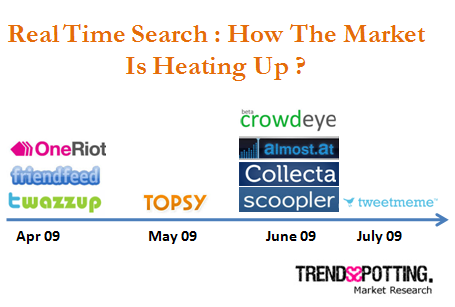
real time search heating up

Hype Cycle Of Real Time Search:

For a qualitative visualization of the hype for “real time search”, TrendsSpotting used Gartner’s hype cycle. We plotted “investment interest” (i.e. VC/self funding , acquisitions) vs proxies for “consumer interest” (i.e. Google search trends for “twitter search“) to derive an expectation indicator for the hype.
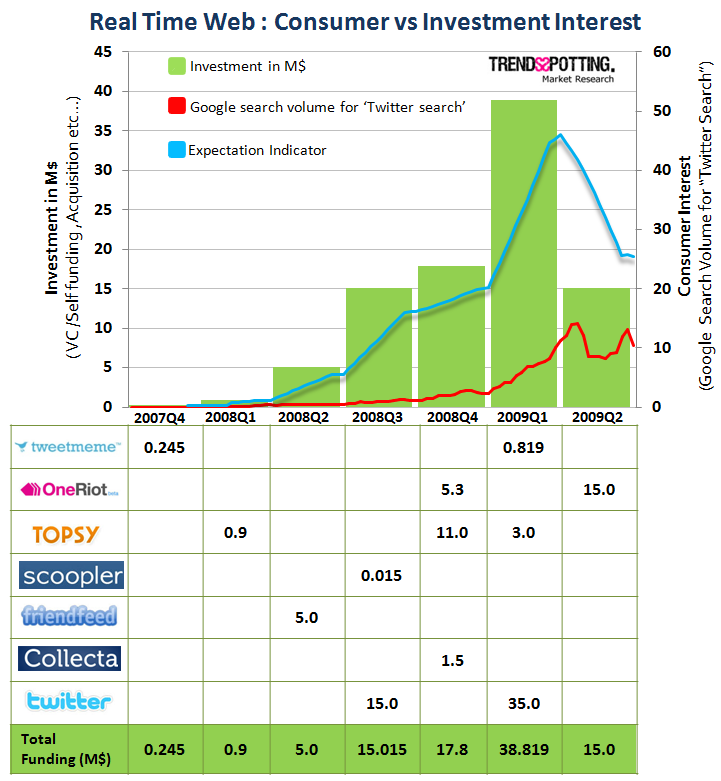
Real time web on Gartner Hype Cycle via Trendsspoting

The green bars plotted against the left hand axis represents ‘Investment interest’ in million dollars (*).

The red line plotted against the right hand axis is a proxy for consumer interest in real time search or ‘Twitter search’.

The light blue line or the ‘expectation indicator’, plotted against right hand axis, combines the two and provides evidences of the hype fast moving towards ‘peak of inflated expectations’.

What can we learn from this ?

TrendsSpotting predictions :

  • We predict that many new players would enter into this market & further investment interest would continue to rise. As a result the ‘expectation indicator’ would continue approaching the ‘peak of inflated expectations’ in the upcoming months.
  • Currently real time search is ubiquitous to ‘twitter search’. However in the upcoming months with consumer interest real time search would emerge as a category on its own.
  • Twitter has been a darling to the media & journalist fraternity. Many among those are the top bloggers & Twitter influencers. The amplified tendency in breaking news by the media fraternity would continue generating over-enthusiasm & some unrealistic expectations around the real time search.

Bottom line:
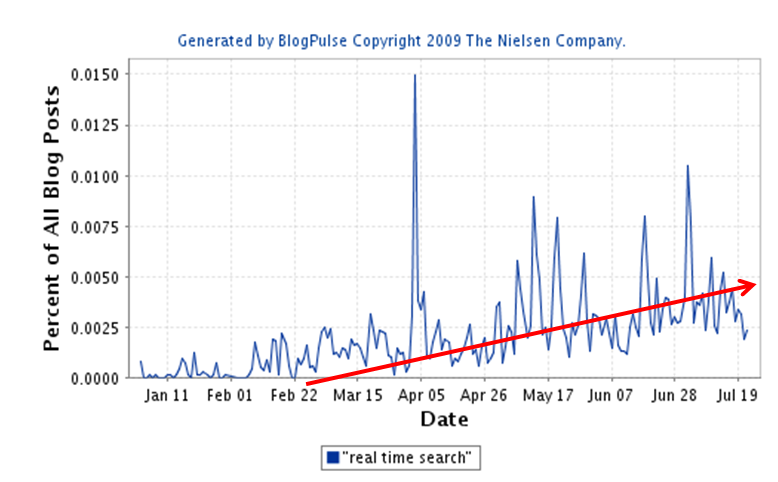
blog pluse buzz for real time search via trendsspotting
The Real Time Search trend will have a noticeable impact by the predicted entrance of big players (as Google) in this direction. Among the frenzy media publicity some of players may develop a successful technology to address the market. However most of the current contenders would fail. That’s the time when the Real Time Search trend is would to lose its expectations. That’s possibly would be the right time to revisit this trend.

*  In the investments count Twitter’s acquisition of Summize (July 08) and Twitter’s series C funding (February 09) were included.

Post to Twitter Tweet This Post Post to Plurk Plurk This Post Post to Yahoo Buzz Buzz This Post Post to Delicious Delicious Post to Digg Digg This Post Post to Ping.fm Ping This Post Post to Reddit Reddit Post to StumbleUpon Stumble This Post

Do Traditional Media Top New Media? Discussion on Corenell’s Research Findings

July 14th, 2009 by

Researchers at Cornell studied the news buzz cycle, the  process by which information becomes news, generates attention and fades. Using computer analysis they were looking  for repeated phrases and tracked their appearances on 1.6 million mainstream media sites and blogs.

Key findings reported:

1.  The biggest text-snippet surge in the study (conducted on quotes and phrases that appeared between August to October 2008) was generated by the phrase “You can put lipstick on a pig.” (phrase originally used by Barack Obama “You know you can put lipstick on a pig, but it’s still a pig“, September 2008 and was perceived as an insult directed to Palin).

2. Cornell  Researchers report that most news flowed from the traditional media to the blogs: The traditional news was found to lead blogs discussions by 2.5 hours on average.

3. Only 3.5 percent of story lines originated in the blogs and later made their way to traditional media.

The Corenell research paper, “Meme-tracking and the Dynamics of the News Cycle,” was written by Jon Kleinberg, Jure Leskovec, and Lars Backstrom. Update findings are presented at memetracker.org.

TrendsSpotting insights:

The research aim and method used by the Corenell researchers are indeed fascinating.  But, I must raise some questions/doubts:

1. Looking at the reported list of media sites ordered by their time lag on reporting a story, I have found many non-traditional sites which might be mistaken for traditional ones. Aggregated media platforms, top media blogs (even those which belong to the traditional ones) can not be considered as traditional media.

2. Blogs might capture shorter terms and not full sentences as searched for by the researchers.

3. Twitter’s news spreading can probably change the reserach results.

Post to Twitter Tweet This Post Post to Plurk Plurk This Post Post to Yahoo Buzz Buzz This Post Post to Delicious Delicious Post to Digg Digg This Post Post to Ping.fm Ping This Post Post to Reddit Reddit Post to StumbleUpon Stumble This Post

Facebook’s Naked Reality: Social Networks Research Insights

July 10th, 2009 by and

It’s already an established phenomenon that in the social networking era friendship is more virtual and 6 degrees of separation has now been reduced to mere 3 degrees. However, seminal work of Dr. Robin Dunbar, an anthropologist, concluded that the cognitive power of the brain limits the size of the social network that an individual of any given species can develop. Extrapolating from the brain sizes and social networks of apes, Dr Dunbar suggested that the size of the human brain allows stable networks of about 148. Rounded to 150, this has become famous as “the Dunbar number”.

However the Dunbar number represents a person’s wider network. The actual number of individuals that represents his social “core network” with whom individuals “can discuss important matters”, numbers only 3 for Americans.

1. Do social networks increase the size of people’s personal networks?

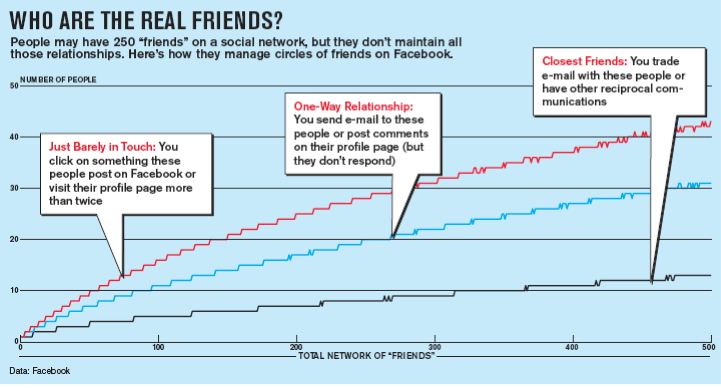
Research findings of Dr. Cameron Marlow, the “in-house sociologist” at Facebook, suggests that the average number of “friends” in a Facebook network is 120, consistent with the Dunbar number.

Facebook real friends-Trendsspotting

Image Source: Business Week

Interesting to observe here that the number of people on an individual’s friend list with whom he (or she) frequently interacts is remarkably small and stable. For example, an average Facebook user—one with 120 friends—generally trades emails or responds to the postings of only 7 closets friends. But, as  Facebook’s team reveals, social network interactions as taken at Facebook brings users to passively engage with 2-2.5 times more people in ones network (passive friends with whom a Facebook user maintains either ‘one-way relationship’ or ‘just barely in touch’).

2. Is online social networking as local as offline social networking?

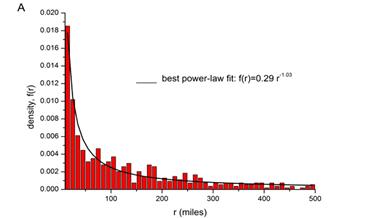
Researchers at Hebrew University analyzed the messaging habits of 100,000 Facebook users by zip code & observed that the volume of e-mail traffic as a function of geographical distance follows an inverse power law i.e. the more local the sender-receiver, the higher the density of messages.
Distance power law

Our take :

Arrow4_RED Highly interactive social platforms as Facebook can extend to a degree (“2x increase in connectivity”) the communication outside a person’s core network.

Arrow4_RED Technology would continue enabling an environment conducive to ‘overshare‘, but we would still maintain a pattern of intimacy preferably with those who are located over shorter distance.
Avg number of friends-Trendsspotting
Image Source: Universal McCann

Post to Twitter Tweet This Post Post to Plurk Plurk This Post Post to Yahoo Buzz Buzz This Post Post to Delicious Delicious Post to Digg Digg This Post Post to Ping.fm Ping This Post Post to Reddit Reddit Post to StumbleUpon Stumble This Post

Michael Jackson’s Farewell Trends: Research Presentation By Trendsspotting.com

July 7th, 2009 by

Post to Twitter Tweet This Post Post to Plurk Plurk This Post Post to Yahoo Buzz Buzz This Post Post to Delicious Delicious Post to Digg Digg This Post Post to Ping.fm Ping This Post Post to Reddit Reddit Post to StumbleUpon Stumble This Post

Android’s Hype Cycle: Will Netbooks Revive It?

July 2nd, 2009 by

It’s almost the time to review Android . We reported earlier that Google’s announcement on Android raised lots of doubts & ambiguity over the web. Moreover this much touted “iPhone 2.0” competitor demonstrated relatively low effect on web.

Last September T-Mobile launched the world’s first Android-powered mobile phone in partnership with Google & recently the software giant expected that around 18-20 phones from 8-9 manufacturers on the market worldwide will be based on the Android operating system.

Riding on the hype Android’s US market share on mobile OS surpassed 6%, its application store hosted around 5,000 applications (in comparison to Apple’s 50,000-plus) until this happened at the Computex Taipei electronics show in May 2009 :

Gartner announced Android running on devices was “snappy” & stopped endorsing the platform saying that Android is a work-in-progress. However, backed by the strong Google brand Android may be an alternative to Windows in Netbooks.

We have attempted to put in place the evidences for the hype cycle curve for Android & in the absence of a perfect measure we have relied on proxies to derive the Y axis of the cycle as ‘Expectations’ -more precisely the red trend line describes the summation of “shared interest indicator” & “market share”. We used Google Trends (US search volume) as an indicator of shared interest & Android’s OS share in US market as an indicator of market penetration & real progress.
Androids Hype cycle -Trendsspotting

So what can be learned from this Android graph and its “Expectation” measure ? Android appears to have had a plateaued growth to the peak of inflated expectations – followed by a quick fall since May end when its mobile OS market share nosedived to less than 1%. Possibly that’s an indication of Android approaching the trough of disillusionment.

Research firm Strategy Analytics have previously suggested that Android will be running on about 12% of global smartphones by 2012. Another estimates from IDC suggests that netbook shipments will grow from 11.4 million in 2008 to 22 million in 2009, a potentially massive growth area for Android.

Will Android find its slope of enlightenment & subsequently its plateau of productivity via netbooks growth (or smartphones) that remains to be seen, possibly when we revisit this trend again in future.

More on Gartner Hype cycle here.

Post to Twitter Tweet This Post Post to Plurk Plurk This Post Post to Yahoo Buzz Buzz This Post Post to Delicious Delicious Post to Digg Digg This Post Post to Ping.fm Ping This Post Post to Reddit Reddit Post to StumbleUpon Stumble This Post

Digital Consumers are Brand Minded Targets

June 29th, 2009 by

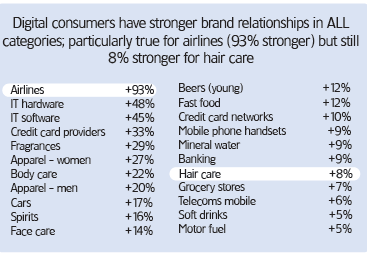
Millward Brown research was conducted on WPP’s BrandZ brand equity global database. Findings show that, on average, digital* consumers have a 15 percent stronger relationship with brands than non-digital consumers.

Strongest brand relationship was found for the airline brands where digital consumers’ brand relationships were nearly twice as strong as those of their offline counterparts.

Other key categories where digital consumers had stronger relationships than non-digital consumers included IT hardware and software (48 percent stronger), credit cards (33 percent stronger) and fragrances (29 percent stronger).

digital_consumers_industry

The digital advantage was found throughout the world, with correlations to internet penetration (Japan and Taiwan (+ 36%) scored the highest average digital relationship differences).

digital_consumers_countries

* Digital consumers were defined as those who have bought from or searched for information about an individual category online.

** Millward Brown report was compiled using 2008 BrandZ data – a total of over 100,000 consumer interviews and over 8,000 brand measurements. These interviews covered 24 countries and an average of 15 categories per country.

Post to Twitter Tweet This Post Post to Plurk Plurk This Post Post to Yahoo Buzz Buzz This Post Post to Delicious Delicious Post to Digg Digg This Post Post to Ping.fm Ping This Post Post to Reddit Reddit Post to StumbleUpon Stumble This Post

« Previous Entries Next Entries »

Real Time Web Analytics